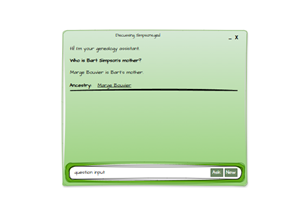
The Epiphany: Stop Matching, Start Classifying
Then, buried in a GPT transcript, I found this gem:
Instead of “which items are similar?”, think: What slot is this question filling?
TYPE = PARENTS | BIRTHPLACE | JOB | AGE | OTHER
Then route based on TYPE.
This is brilliant because:
- It’s simpler
- It’s more structured
- It’s easier for small models
- It avoids fuzzy semantic similarity
- It reduces the problem to a single label
And because everything GPT says is brilliant and works.
So I tried it.
Test 1: Parent Questions
Classify this question into exactly one of: MOTHER, FATHER, OTHER.
Return only the label.

User: "Who is Bart's mom?"
→ MOTHER

User: "Who is Bart's dad?"
→ FATHER

User: "Where was Bart born?"
→ OTHER
Success!
I could work with this.
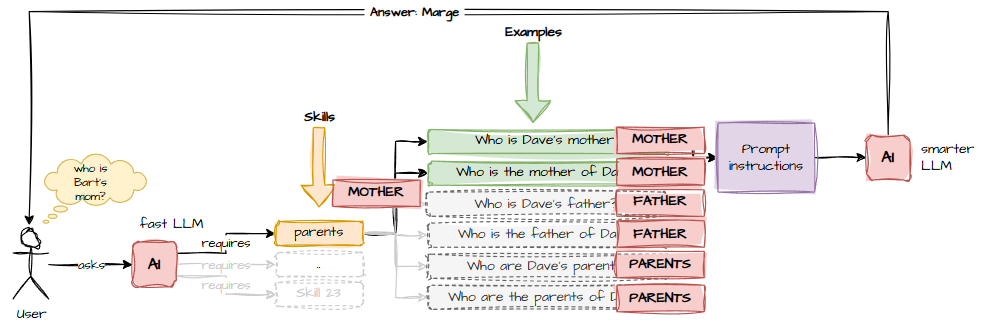
Then I added PARENTS.
And Llama said:

Cue the sound of my head hitting the desk.
Undeterred, I tweaked the prompt:
Pick the most specific.And suddenly:
- “Who is Bart’s mom?” → MOTHER
- “Who are Bart’s parents?” → PARENTS
Victory! (Temporary, hollow victory, but still.)
As someone who is neurodivergent, I feel qualified to say this: working with Llama is like giving instructions to someone who takes everything literally. It will follow your words precisely – and miss the meaning entirely.
Extending the Approach: Multi‑Label Classification
Sometimes you want multiple labels. For example:
- “Who are Bart’s parents?” could reasonably return MOTHER, FATHER
- And you might attach both examples to the “parents” skill
So I tried:
If it matches multiple, provide a comma‑delimited list.And yes, it returned MOTHER, FATHER instead of PARENTS.
This is fine, as long as you understand how the model behaves and route accordingly.