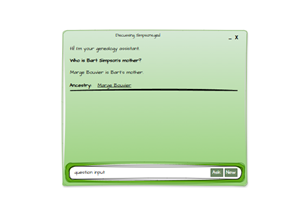
Follow‑Up Questions: The Real Fun Begins
A follow‑up question means repeating the entire dance, but with more context:
- Prompt
- Question 1
- Tool call
- Data
- Answer 1
- Question 2
- …
Let’s visualise it:
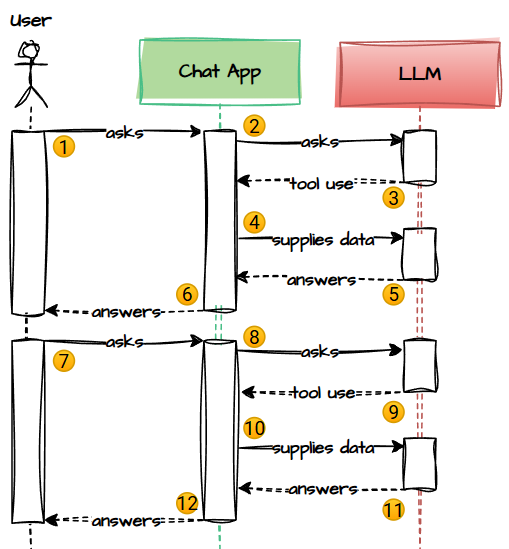
- User types question
- App determines skill + examples, sends prompt + question
- LLM asks for a tool
- App sends everything + tool call + data
- LLM replies with an answer
- App displays answer
- User asks follow‑up
- App sends new prompt + full conversation + new question
- LLM asks for a tool
- App sends everything + tool call + data
- LLM replies
- App displays answer
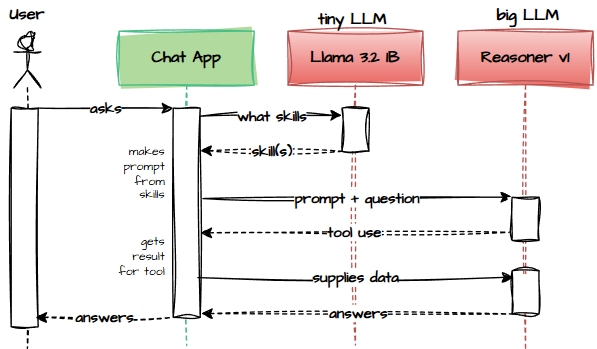
And yes, we skipped the part where a different LLM determines the skill. Let’s add that back in:
Chaining Questions and Answers
We’re not limited to a single tool call per question. The LLM can ask for multiple tools in one go.
Example:
“How old are Bart and Lisa?”
LLM replies:
``` get-data:Bart```
``` get-data:Lisa```
You return the data, and it answers:
“Bart is 10 years old and Lisa is 8 years old.”
Brilliant.
But some questions require sequential reasoning.
Example:
“Where was Dave born? And which counties neighbour that place?”
To answer:
- First find Dave’s birthplace
- Then find neighbouring counties
Models like Reasoner v1 can handle this, but you need two mechanisms:
- If the LLM asks for a tool, you provide the data and ask again
- You detect FINAL ANSWER: to know when it’s done
This loop continues until the LLM stops asking for tools and finally answers the question.