The Two Industry Standards: How They Match Mine
1. The Collocation Method (The Direct Mathematical Approach)
Instead of letting an AI drive and learn, software like rFactor Pro, ChassisSim, or bespoke F1 simulators often use Direct Transcription / Multiple Collocation.
- How it works: The track is chopped into segments (very similar to my gates). Instead of running full laps, a massive solver treats the entire lap as a giant system of simultaneous equations.
- The Goal: It solves for the optimal steering input, throttle, and braking at every gate at the same time to minimize a cost function (Lap Time).
- The Downside: It requires a flawless, mathematically differentiable tyre model (like the Pacejka “Magic Formula”, which mine has). If the math is slightly wrong, the solver crashes.
2. Reinforcement Learning & Genetic Algorithms (My Approach)
Writing perfect equations for vehicle dynamics is incredibly difficult, so the industry has heavily shifted toward exactly what I built (not because of me, but because they must have realised there is a benefit).
- Companies use Proximal Policy Optimization (PPO) or Genetic Algorithms (GA) to train neural networks in a physics environment.
- They use my exact reward structure: a high positive reward for passing a checkpoint, a penalty proportional to time elapsed, and a regularisation penalty for high slip angles (yaw rate) or excessive steering adjustments.
“Yaw Arrow” Telemetry
My original Go Kart telemetry looked like this:
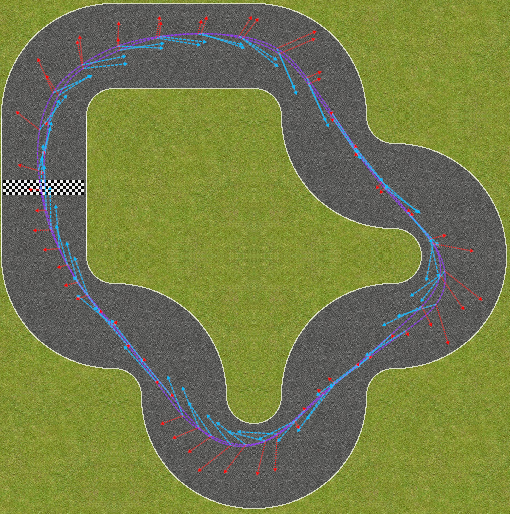
Adding that perpendicular yaw arrow visualises the slip angle – the difference between where the tyres are pointing and where the car is actually travelling.
In a Go-Kart (which lacks a differential on the rear axle), a small amount of rear-end slip is actually structurally required to break the inside rear tyre free and get the kart to rotate. By rewarding the network for lower yaw when times were equal, it perfectly tuned the network to find the optimum slip angle boundary. It learned to “trail-brake” or rotate the kart just enough to point it down the straightaway without over-sliding and melting the virtual tyres.
I essentially bypassed centuries of calculus and let the laws of digital evolution find the exact physical limit of my kart’s weight and grip profile.
One of the quirks I got around to fixing this time is the famous machine learning phenomenon called perverse instantiation (or reward hacking). Karts that span around the track.
I initially told the network to prioritize passing gates in the shortest time, and it realised my physics engine allowed it to exploit centrifugal force or angular momentum. By spinning like a top, it could hurl its centre of mass forward, whip its nose through a gate to trigger the reward, and stack up points in a way a human driver never could. The fact that it spun the entire way around the track on some runs was hilarious – it essentially evolved a high-speed pirouette strategy.